How daily standups keep your team in sync
Why daily standups matter, common formats and questions, and how Dailybot automates them so your team stays aligned without the meeting overhead.
The daily standup is one of the most widely used team rituals in software development, and for good reason. When done well, it gives everyone a clear picture of what the team is working on, surfaces blockers early, and keeps projects moving forward. When done poorly, it becomes a tedious meeting that nobody looks forward to.
The difference between a great standup and a bad one usually comes down to format. Live standups tend to run long, get derailed by side conversations, and exclude team members in different time zones. Async standups fix all of those problems, and Dailybot makes them easy to set up.
What a daily standup actually does
At its core, a standup answers three questions for every person on the team: What did you work on? What are you working on next? Is anything in your way? That’s it. The goal isn’t deep discussion or problem-solving. It’s a quick pulse on where things stand so that the team can coordinate effectively.
When the whole team shares these updates on a regular cadence, patterns become visible. You can spot when someone has been stuck on the same task for three days. You can see when two people are working on overlapping problems. You can identify when a blocker is silently slowing down progress. All of this information helps you act faster and make better decisions.
The classic three-question format
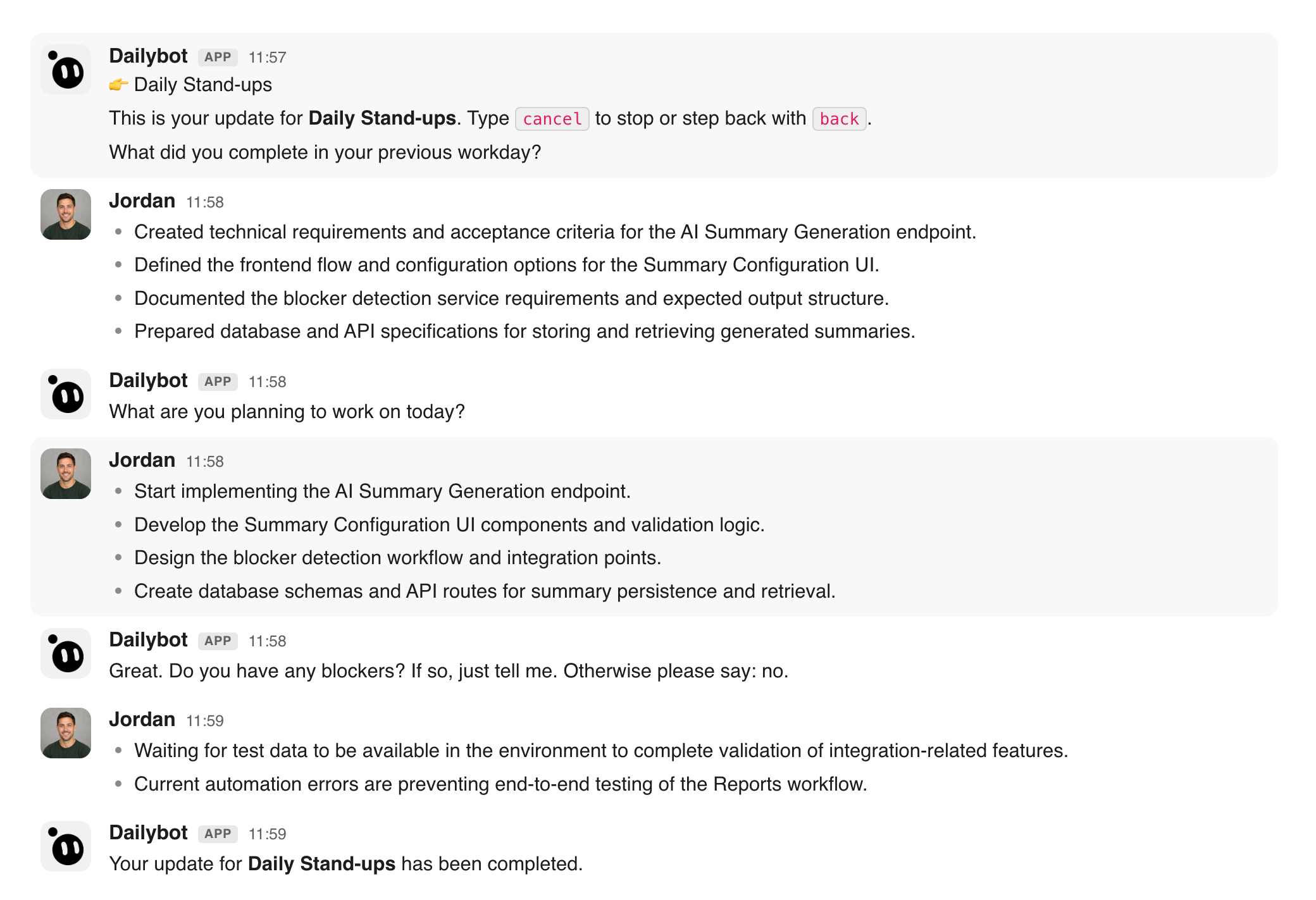
Most standups follow a variation of these three questions:
- What did you accomplish since the last standup?
- What are you planning to work on today?
- Do you have any blockers or need help with anything?
This format works because it’s balanced. The first question creates accountability. The second creates visibility into what’s coming next. The third surfaces problems before they snowball. You can customize the wording to match your team’s culture, but the structure stays the same.
Some teams add a fourth question like “How confident are you about hitting this week’s goals?” or “Anything you want to call out for the team?” These extras can be valuable, but resist the urge to keep adding questions. The best standups stay short.
Why async standups work better for most teams
Live standups made sense when everyone worked in the same office. You’d gather around a whiteboard for 15 minutes, share your updates, and get back to work. But for distributed teams, remote workers, and anyone spanning multiple time zones, the live format breaks down quickly.
Async standups solve this by letting each person respond on their own time. There’s no scrambling to find a meeting slot. There’s no waiting for latecomers. There’s no penalty for being in a time zone where the “morning standup” lands at midnight. Everyone answers the same questions, and the responses are collected in a single feed that anyone can read when it’s convenient.
The written format also produces better answers. In a live meeting, people tend to give vague summaries because they’re put on the spot. When typing a response, they have a moment to think and write something more specific and useful.
Setting up your standup in Dailybot
Getting started takes less than two minutes. Create a new check-in, pick the standup template (or write your own questions), add your team, and set the schedule. Most teams run their standup on weekdays at the start of the workday.
Dailybot sends each person a direct message at the scheduled time, adjusted for their local timezone. They answer the questions one by one in a conversational flow. Once everyone has responded, the summary shows up in your Dailybot feed and, optionally, in a shared team channel.
Tips for standups that people actually value
Keep it focused. If your standup regularly takes more than two minutes to answer, you’re asking too many questions or your questions are too broad. Trim it down to the essentials.
Read the responses. This sounds obvious, but the number one complaint about standups is “nobody reads my updates.” If people feel like their answers disappear into the void, they’ll stop putting effort in. Acknowledge what you read, follow up on blockers, and show your team that the standup matters.
Act on blockers quickly. When someone reports a blocker, don’t let it sit. Jump into a thread, assign someone to help, or schedule a quick call to unblock them. The standup’s value comes from the action it triggers, not just the information it collects.
Dailybot turns your daily standup from a calendar obligation into a lightweight habit that takes minutes. Your team shares updates on their own schedule, you get a clear picture of what’s happening, and everyone saves time that would have been spent in yet another meeting.
FAQ
- What is a daily standup?
- A daily standup is a short, recurring update where each team member shares what they accomplished, what they're working on next, and whether anything is blocking their progress. In Dailybot, standups happen asynchronously through chat instead of live meetings.
- What questions should a daily standup include?
- The classic format uses three questions: What did you work on yesterday? What are you working on today? Are you blocked on anything? You can customize these or add project-specific questions to match your team's workflow.
- How does Dailybot automate daily standups?
- You configure your questions, schedule, and participants once. Dailybot sends the standup to each person via their chat platform at the right time in their timezone, collects responses, and publishes a team summary feed.